
You already have a bank account, a credit card, and maybe years of history with the same branch. Calling your bank for a mortgage feels like the obvious next step. But a familiar place is not automatically the best fit for every mortgage file.
Most first-time home buyers I meet ask the same thing.
Should I go to my bank, or talk to a mortgage broker?
Neither route is automatically better for everyone. The right starting point depends on your income, credit, debts, and down payment. It also depends on the property, your timeline, and how much you want to compare.
This guide focuses on choosing between the two paths. For the complete stage-by-stage explanation, read what a mortgage broker does for a first-time home buyer.
TL;DR
- A bank reviews your application under one institution’s products and lending rules.
- A broker can compare eligible options across multiple lender categories.
- A bank may be enough when your income, credit, down payment, and property are straightforward.
- A broker is often more useful when you want comparison, or you have self-employed income, newcomer status, gifted funds, credit issues, or a previous decline.
- Compare the full mortgage structure, not only the advertised rate.
The best first call is the one that gives you a realistic budget and a financeable plan before you make an offer.

A Bank and a Mortgage Broker Approach the Same File Differently
The difference is not about who is friendlier. It is about how your file gets reviewed.
When you apply directly through a bank, a representative offers the products that the institution sells. Your application is judged under that lender’s policies.
If you fit those policies, the process is simple and direct. If you do not, a decline usually means your file did not match that one bank’s rules. It is not a verdict on you.
A broker starts a step earlier. First I look at the borrower, the down payment, the property, and the timeline.
Then I compare your file against eligible options from different lender categories. That can mean traditional, alternative, or private lenders where it fits. I also walk you through the rates, terms, conditions, fees, and tradeoffs, so you choose with full information.
Here is something I have seen firsthand. I worked as a mortgage specialist inside three major Canadian banks before moving to the broker channel.
The same buyer can get different answers under different lender policies. How each lender reads a file is the part that never shows up on a rate sheet.
Mortgage Broker vs Bank: Quick Comparison
| Decision Point | Applying Through a Bank | Working With a Mortgage Broker |
| Lender options | One institution’s products | Multiple eligible lenders and lender categories |
| Approval criteria | One lender’s policies | File compared against different lender criteria |
| Rate comparison | Limited to the bank’s available offers | Comparison across accessible lender options |
| Non-standard income | Must fit that bank’s documentation rules | Can be matched against lenders that accept different documentation |
| Application support | Support for that bank’s process | Support with lender selection, submission, conditions, and closing |
| Cost | No broker fee, although transaction costs may still apply | Often lender-paid for standard residential mortgages. Disclosed fees may apply to some alternative, private, or complex files |
A broker does not represent every lender in Canada, so ask which lenders are being compared and whether your own bank should also give you a direct quote.
When Applying Directly Through Your Bank Can Make Sense
Sometimes your bank is a perfectly good place to start. The clearest sign is a straightforward file.
That usually means stable salaried or T4 income, established credit, and manageable debts. Your down payment is documented, the property is a standard owner-occupied home, and there is no recent decline or urgent deadline.
Comfort matters too. Some buyers prefer the institution where they already hold their accounts, and a direct bank offer gives you a solid number to compare against.
Just do not let familiarity end the review too early. Even with your own bank, ask:
- Is the quoted rate conditional on opening other products?
- How deeply were my documents reviewed before this pre-approval was issued?
- What is the penalty if I break the mortgage early?
When a Mortgage Broker Can Add More Value
Most buyers who call me are not chasing a rate. They are stuck on a worry.
I hear the same lines often.
- “I am not sure what I can actually afford.”
- “My income looks different on paper than it does in real life.”
- “The bank turned me down, and I do not know what comes next.”
- “I do not understand the documents, conditions, and next steps.”
If any of those sound like you, a broker can add real value.
A broker helps most when you want a broader comparison. One file, several lenders, side by side, on rules, rates, terms, penalties, and conditions.
It also helps when your income or down payment needs explaining. That covers a few common cases:
- Self-employed income with big write-offs
- Contract or commission income
- A recent job change
- A gifted down payment that needs a paper trail
Newcomers are another clear case. Your income and savings can be strong even when your Canadian credit history is short, and the lender still needs a complete, well-documented file.
If you recently arrived in Canada or are still building Canadian credit, review these newcomer mortgage options before you treat one bank’s answer as the final answer.
Bank Pre-Approval vs Broker Pre-Approval: Ask How Much Was Actually Reviewed
Two pre-approvals can carry the same name and mean very different things. Some involve a real review of your income, down payment, debts, and credit. Others are closer to a quick estimate. So ask what was actually checked:
- Were my income documents reviewed?
- Was my credit checked?
- Was my down payment source reviewed?
- What still has to be approved once I choose a property?
A pre-approval is not final approval. There is also a stress test. Federally regulated lenders qualify most new uninsured mortgages at the higher of your contract rate plus two percent, or 5.25 percent (OSFI). So your real budget sits on a payment higher than the one you expect to make.
For the full walkthrough of documents, rate holds, property review, and final approval, read the mortgage pre-approval process.
Before booking showings, ask me to review how thoroughly your current pre-approval was done.
The Lowest Rate Can Still Be the More Expensive Mortgage
A rate is easy to compare. The rest of the mortgage is where the real cost hides.
Here is a common Ontario example. A first time home buyer buys a condo in Mississauga and plans to stay five years.
Three years in, a job change or a growing family forces a move. A restrictive mortgage or a large break penalty can wipe out the small rate saving that won the buyer over.
I see this often. Buyers compare rates to the second decimal place while overlooking what it costs to change the mortgage before the term ends.
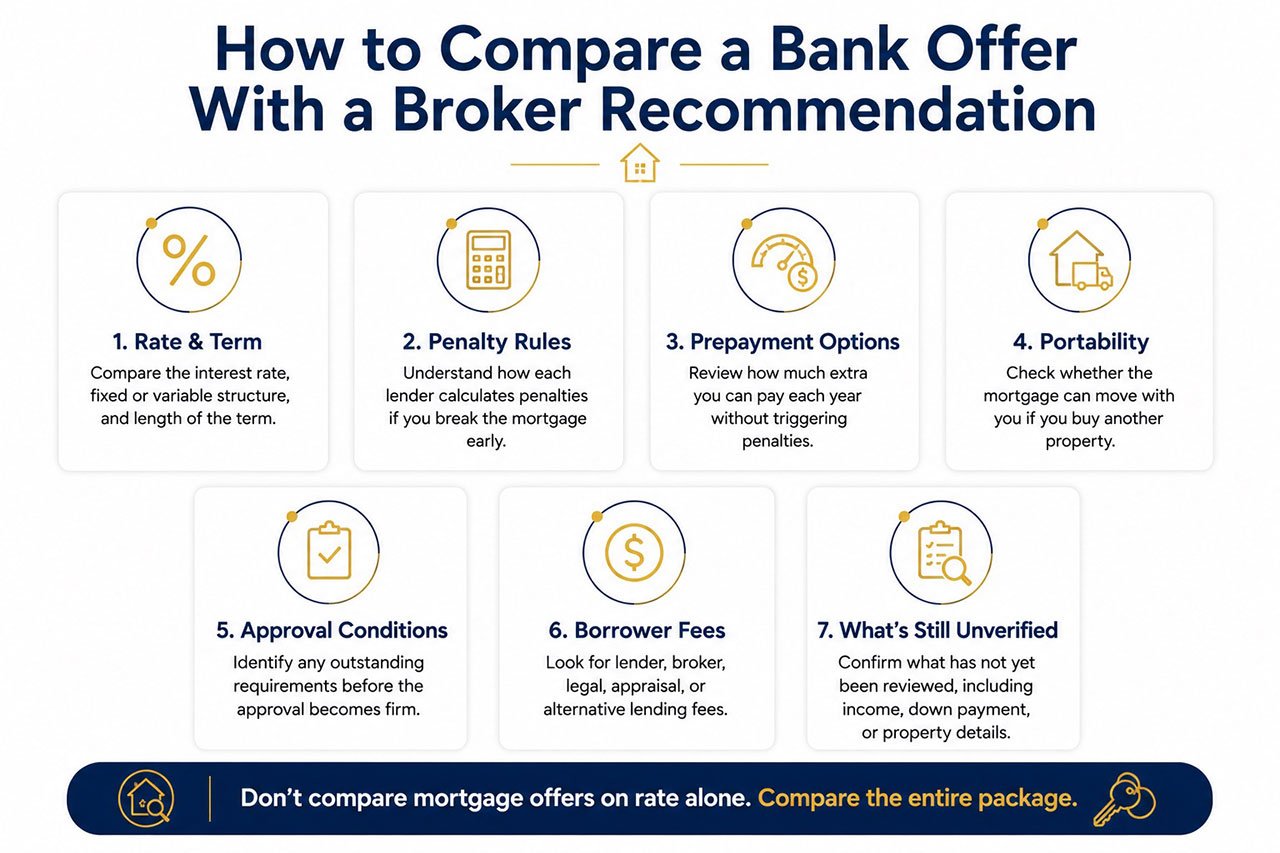
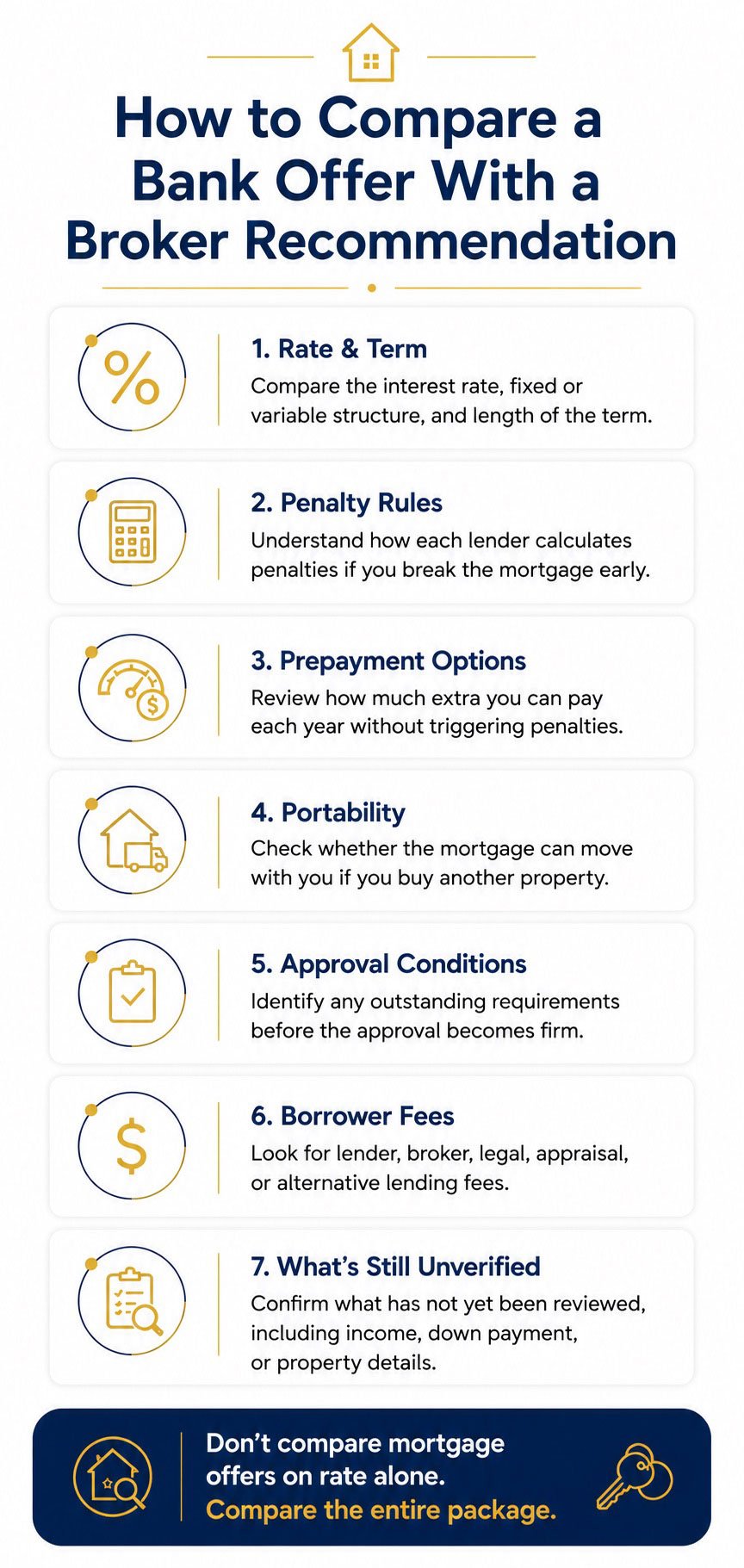
How to Compare a Bank Offer With a Broker Recommendation
Have two offers in front of you? Line them up on the same points, not just the rate:
- Rate and term: the rate, fixed or variable, and how many years it is locked for.
- Penalty calculation: how a break penalty is worked out, since methods differ a lot.
- Prepayment privileges: how much extra you can pay each year without a penalty.
- Portability: whether you can carry the mortgage to your next home.
- Approval conditions: what still has to be met before the deal is firm.
- Borrower-paid fees: any fee you pay directly, rare on standard files but possible on alternative or private ones.
- What remains unverified: anything the lender has not yet checked, such as income, down payment, or the property.
Two offers can show the same rate and still cost very different amounts over the term. Compare the whole picture before you choose.
Down Payment and Cash to Close Can Change the Better Route
Where your money comes from can shape which lender path fits best. Both a bank and a broker check the source of your down payment and how long the funds have been in your account. They also check that you have enough left for closing costs and a reserve.
Location changes the math. A Mississauga condo buyer needs qualification room for monthly maintenance fees. An Oakville freehold buyer faces different property-tax and heating costs. The lender looks at the full cost of owning the home, not just the mortgage payment.
Before you decide which lender path to take, work out the down payment requirements for first time home buyers and the extra cash you need for closing.
If part of your savings sits in an FHSA, check how the First Home Savings Account fits your withdrawal timing and proof of funds.
What a Bank Decline Actually Tells You
A decline feels like the end. It is usually just new information.
It points to three paths:
- Fix the file, by clearing a credit error, paying down a debt, or adding stronger documents.
- Try another lender, since a different lender may read your file differently.
- Pause, and strengthen the file before you make an offer.
One bank’s decline is information, not a guarantee that another lender will say yes.
What Personal Guidance Changes During the Process
Client experience:
“Deepika Grover was a total game-changer. She’s proactive, incredibly organized, and made the mortgage process feel straightforward from day one. She kept me updated at every step, answered questions quickly, and explained the details in a way that actually made sense. If you want someone who’s responsive, honest, and on top of everything, Deepika is the person to call.”
Viren Patel, Google review
For many first time home home buyers, the deciding factor is not only who quotes a rate. It is whether someone can explain the conditions, organize the paperwork, and keep you informed when deadlines get tight.
Decision Guide: Should You Start With a Bank or a Mortgage Broker?
| Your Situation | Sensible Starting Point |
| Stable salaried income, established credit, clear savings, and a standard property | Bank or broker |
| You want to compare more than one lender | Mortgage broker |
| Self-employed, contract, commission, or variable income | Mortgage broker |
| New to Canada or building Canadian credit | Mortgage broker |
| Gifted down payment or several funding sources | Mortgage broker |
| Previously declined by a bank | Mortgage broker review |
| Strong relationship with your bank and a straightforward file | Bank may be sufficient |
| You already have a bank offer but want a second opinion | Mortgage broker |
| Close to making an offer but unsure what was verified | Mortgage broker review before offering |
The more explanation your file requires, the more valuable lender comparison becomes.
Choose the Route That Gives You Clarity Before You Make an Offer
So, bank or broker?
A bank can work well for a straightforward first-time home buyer. You value a familiar institution, and you are comfortable reviewing one lender’s offer.
A mortgage broker is usually the stronger starting point when you want comparison, have a complex file, or need guidance through qualification and conditions.
Base the choice on the full mortgage structure and the approval process, not on familiarity or the lowest advertised rate alone.
A quick word on honesty. No broker can guarantee approval, the lowest market rate, an appraisal value, or a closing date before the lender finishes its review. Legal, tax, and real estate advice has to come from the right professional. What a broker can do is compare your eligible options and guide the file.
Before making an offer, book a free consultation with me. I will review your income, debts, down payment, documents, target property, and any current bank offer. Then I will explain whether staying with the bank or comparing other eligible lender paths makes more sense for you.
Grover Mortgage Group works with first-time home buyers across Mississauga, Oakville, Burlington, Brampton, Hamilton, Toronto, and nearby GTA communities.